8.3.1Can I build a model?

Cross-Sections Lab: General Case

8-97.

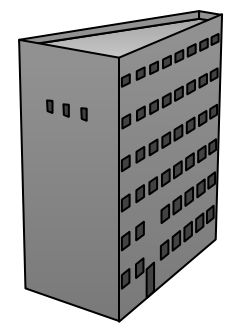
Are there other kinds of solids that are not revolved about a particular line where we can slice and accumulate the volumes? Will any shape work? Do the slices need to be circular? What conditions make a solid a good candidate for slicing and accumulating the volumes of each slice? With your team, discuss each of the solids below. For which solids do you believe accumulation of slices is a good method for computing the volume? Why?
  1. Your teacher will provide you with a model.

  1. Your teacher will provide you with a model.

  1. Your teacher will provide you with a model.

  1. Your teacher will provide you with a model.

8-98.

The Goodslice Baking Company is famous for making sandwich bread. When sliced, each piece of bread forms a square. Although each slice has the same thickness, the area of the square is not the same for all slices.

  1. Draw an example of a slice of Goodslice’s sandwich bread on your paper.

  2. Assume that there are n slices. If A(i) determines the area of the ith slice, use summation notation to represent the volume of the entire loaf of bread. Let the thickness of each slice be x.

  3. With your team, discuss how to compute the exact volume of the loaf. Write down your conclusions.

8-99.
Your team will be building a three-dimensional model of a solid with similar cross-sections.
  1. On a piece of cardstock, draw a two-dimensional shape roughly the size of a sticky note folded in half. The more irregular your shape is, the more interesting your cross-sections will be.
  2. Your teacher will provide your team with a cross-section description. Using play dough, build on top of your two-dimensional base shape so that every cross-section fits the cross-section description given to your team.
  3. Be prepared to present your model to the class. During your presentation be sure to:
    1. Describe the shape of your model’s cross-section.
    2. Explain all of the ways you can slice to get the cross-section shape. Discuss slicing directions that will not give the cross-section shape.
    3. Demonstrate your shape by physically removing a “typical” cross-section.
8-100.

Summarize a method for calculating the volume of a “typical” cross-section. How can you approximate the total volume of your solid?

Review and Preview problems below

8-101.

Cavalieri’s principle states that if two solids have equal height and all corresponding cross-sections have the same area, then the solids have the same volume. This relationship holds even when the two solids do not have the same shape. Examine a deck of cards to help explain why this must be true. Homework Help ✎

8-102.

The graph at right shows f(x)=12xcos(x)+4 for 0x5. Write an integral that will compute the volume of the solid when this region is rotated about: Homework Help ✎

  1. The x-axis.

  2. The y-axis.

  3. The line x=6.

  4. The line y=7.

First quadrant curve labeled, f of x, starting at the point (0, comma 4), rising to about (1, comma 4.5), changing from concave down to concave up at about x = 2, turning at approximate point (3.5, comma 2.5), continuing up & right, shaded region below the curve, above x axis, right of y axis, and left of x = 5.

8-103.

Multiple Choice: ddx[arccos(3x)]= Homework Help ✎

  1. 31x2 

  1. 13sin(3x) 

  1. 313x2 

  1. 319x2

  1.  39x21

8-104.

Multiple Choice: A particle has a velocity of v(t)=t+sin(t) over the interval 0tπ. The average velocity of the particle is: Homework Help ✎

  1. 1 

  1. π2+2π 

  1. π22 

  1. 12 

  1. 2π 

8-105.

Multiple Choice: If F(x)=0x9tdt, which of the following statements are true? Homework Help ✎

  1. F(5)=2 

  1. F(7)>F(5) 

  1. F is concave downward 

  1. I only 

  1. II only 

  1. I and III 

  1. II and III 

  1. I and II 

8-106.

Multiple Choice: The population P of a city is growing according to the equation dPdt=0.02P+357 . The current population of the city is 18,000. Assuming the same pattern of growth, what will be the population be in six years? Homework Help ✎

  1. 18,351 

  1. 20,250 

  1. 21,348 

  1. 22,571 

  1. 23,374 

8-107.

Multiple Choice: If y=3x12, then the minimum product for xy is: Homework Help ✎

  1. 3 

  1. 0 

  1. 9 

  1. 12 

  1. 18 

8-108.

Multiple Choice: Given the graph of y=f(t) at right and g(x)=0xf(t)dt. Which of the graphs below could be the graph of y=g(x)? Homework Help ✎

  1. X axis with points labeled, A & b, Curve starting on the positive y axis, concave down, turning up but still concave down at point on x axis labeled, a, turning down halfway between a & b, & stopping at point on x axis labeled, b.

  1. X axis with points labeled, A & b, Curve starting on the positive y axis, passing through the x axis between the origin & point labeled a, turning up at x = a, changing from concave up to concave down half way between a & b, stopping at a higher y value at x = b.

  1. X axis with points labeled, A & b, Curve starting at the origin, turning up at x = a, & negative y value, changing from concave up to concave down half way between a & b, stopping at a positive y value at x = b.

  1. X axis with points labeled, A & b, Curve starting at the origin, turning down at x = a, & positive y value, changing from concave up to concave down half way between a & b, stopping at a negative y value at x = b.

  1. X axis with points labeled, A & b, Curve starting on the negative y axis, changing from concave up to concave down @ x axis 3 fourths of the way between the origin & point labeled a, turning down at about 1 third of the way between, A & b, stopping at the x axis just before x = b.

X axis with points labeled, A & b, Curve labeled, f of x, starting on the positive y axis, concave down, changing to concave up as it passes through the x axis at point labeled, a, turning up half way between a & b, & stopping at point on x axis labeled, b.